

Positano: what you see first, what you feel after, and what stays
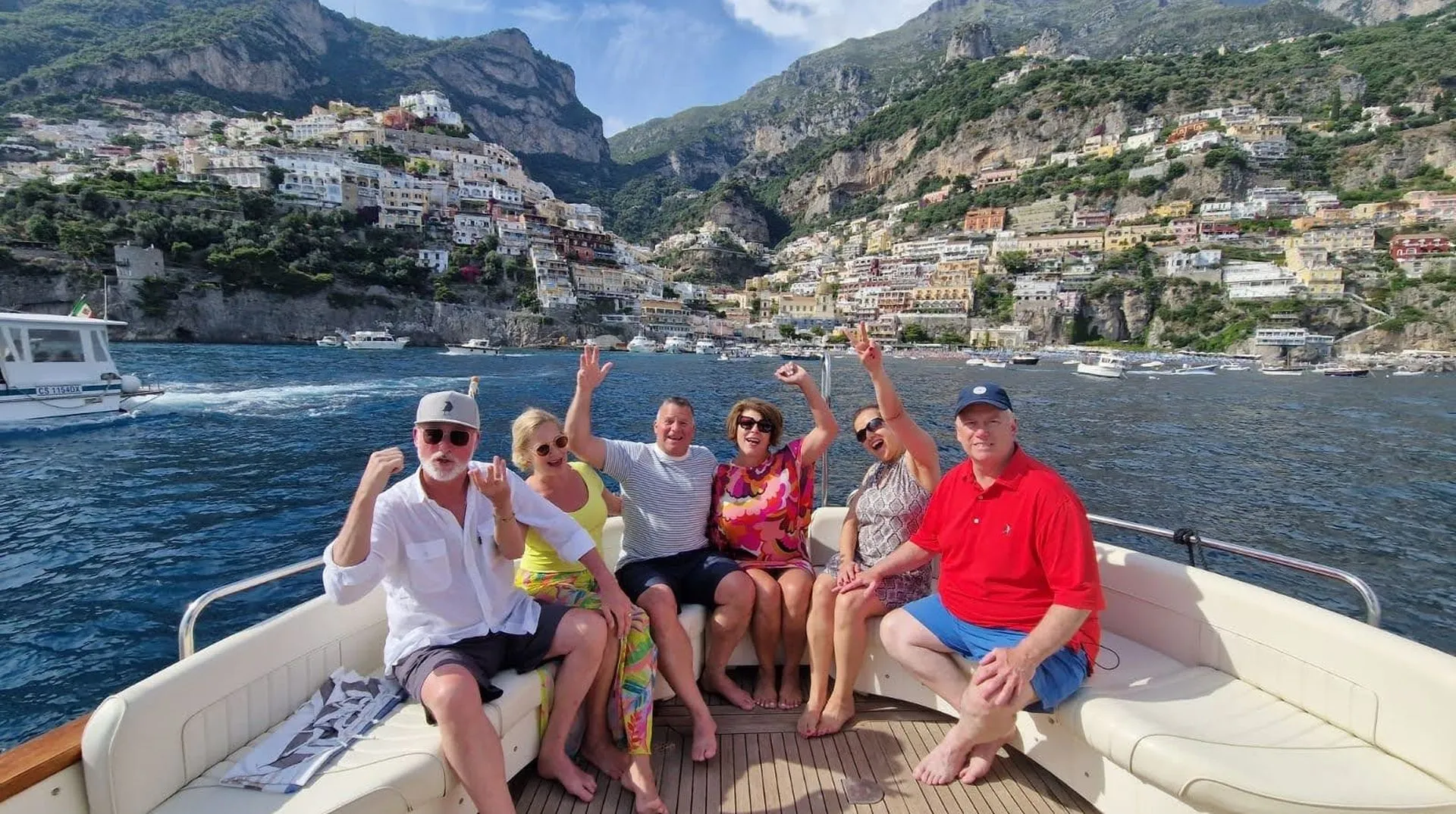
Positano is the kind of place that gets under your skin before you’ve even figured out how it works.
That’s not a cliché – it’s what actually happens.
You arrive with a set of expectations built out of photographs, and then reality starts dismantling them, piece by piece, in the best possible way.
In this guide:
- Why is Positano so famous (and why it still surprises people)
- Things to do in Positano that actually feel worth your time
- What to see in Positano — and what the streets won’t show you
- Best time of year to visit Positano for good weather
- Why arriving by sea changes everything — and what the SS163 really feels like
Why is Positano so famous and why it still surprises people
In 1953, John Steinbeck drove from Rome to Positano on a road he described as something that “corkscrewed on the edge of nothing.” He arrived shaken.
He left changed. What he wrote for Harper’s Bazaar that year set something in motion that never really stopped: a quiet fishing village clinging to a cliff became, slowly, one of the most recognized silhouettes on the planet.
Positano was a prosperous port town that had fallen into decline when larger ships made the harbor obsolete, and by the mid-twentieth century more than half its population had emigrated.
Then Steinbeck arrived. His essay put the place on the literary map with a sentence that keeps getting quoted because nothing has replaced it: “Positano bites deep. It is a dream place that isn’t quite real when you are there and becomes beckoningly real after you have gone.”
That’s the thing about Positano. The famous part – the photo, the view, the stacked houses in terracotta and ochre and pale yellow – that’s just the introduction.
The probable origin of the name comes from the Latin pausa – a place to stop, to rest. The Romans already knew this.
Beneath Positano, only recently discovered, are the remains of a large Roman villa destroyed by the eruption of Vesuvius in 79 AD, buried under layers of ash and mud for two thousand years. So the layers here aren’t just visual. They’re geological, historical, and buried.
Legend has it the town was founded by the Greek god Poseidon, in honor of a nymph named Pasitea.
Whether you believe that or not is irrelevant -Positano still feels like somewhere a god might have built on impulse, without consulting an urban planner.
Paul Klee called it “the only place in the world conceived on a vertical rather than a horizontal axis.” He wasn’t wrong.
Things to do in Positano that actually feel worth your time
Most guides will give you a list. Church, beach, viewpoint, restaurant. Go through them in order, photograph each one, leave. That’s one way to do it.
Here’s another: arrive with less of a plan.
Walk down Via dei Mulini – the main descent toward the sea – but take the side streets when they appear. The ones without signs. The ones that feel slightly like a mistake.
That’s where Positano stops performing and starts just being. Laundry on a line. A cat asleep on a warm step. The smell of something cooking behind a closed door.
Spiaggia Grande is unavoidable, and honestly, don’t avoid it – 300 meters of shore where you might find yourself sharing space with passing VIPs.
But if the crowd bothers you – and in July, when the tour buses park above and empty their contents down the staircases, it will – take the footpath west toward Fornillo Beach. Smaller, rougher, quieter.
The kind of beach where people actually swim instead of posing.
Then there’s the Museo Archeologico Romano, tucked beneath the Church of Santa Maria Assunta – underground, dimly lit, and most tourists walk straight past it. Which is exactly why you should go in.
And the Path of the Gods – Sentiero degli Dei – winding from Bomerano to Nocelle, with views that on a clear day reach all the way to Capri.
What to see in Positano – and what the streets won’t show you
The Church of Santa Maria Assunta: pale stone façade, a yellow, green and blue majolica dome, and inside, a Byzantine icon that predates the church itself by centuries. It sits right above the main beach, almost casual about its own age.
The watchtowers dotted along the coastline look decorative now. They weren’t. Built to defend against Saracen pirates from North Africa, they would light fires to warn neighboring villages that an attack was coming – giving locals just enough time to grab what mattered and move inland.
The sea that looks so generous in daylight was once the direction danger came from.
One thing the streets genuinely cannot show you: the shape of Positano itself. You can’t read it from the inside. You need distance – real distance, the kind you only get from the water – to understand how it’s built, how it manages to stay vertical.
Best time of year to visit Positano for good weather
May and early June – this is where the balance sits. The sea is warm enough to swim. The bougainvillea is at its most violent pink. The streets are full, but not packed – there’s still room to stop, to sit, to actually look at things.
September does something similar but with a different light. The high-summer sharpness softens. The crowds thin slightly. Sunsets get shorter and more amber-toned.
July and August – the weather is extraordinary, but Positano compresses. The narrow streets fill quickly. The SS163 above is a slow-moving procession of buses and rental cars. If you go in August, go early – before the tour buses arrive and before the light turns flat.
Winter is a different creature entirely. Most hotels close, and what remains is a town reduced to its residents, its light, and its bones.
Why arriving by sea changes everything – and what the SS163 really feels like
Most people reach Positano by road. The SS163 – the famous Amalfi Drive – winds along the cliff face, hairpin by hairpin. It’s one of the most photographed roads in Italy.
It’s also, in the high season, one of the most congested. Buses that can barely navigate the bends, rental cars edging past each other, scooters threading wherever they can. You spend the journey managing anxiety rather than looking at the view.
Arriving by sea reverses all of that.
From the water, Positano rearranges itself into something you can actually read. The steepness becomes legible. The houses – which from the road seem to tumble downward in a controlled chaos – suddenly make structural sense.
You see the whole town at once, before you step into it. And the hidden coves around Positano – La Porta, San Pietro, Arienzo – are simply inaccessible from land. No road leads there. No bus stops there. A small boat does.
The Amalfi & Positano shared tours with Sorrento Sea Tours depart from Marina Piccola in Sorrento – never more than 12 people, guide included – and follow the coastline in a way no road can replicate.
For those who want the full day, the Capri & Positano private experience connects the two destinations in a single day that doesn’t feel rushed, moving at your rhythm rather than a bus schedule.
Planning to reach Positano by sea? Read more about the Amalfi Coast tour from Sorrento.