

Blue Grotto Capri: what it actually feels like when you drift inside
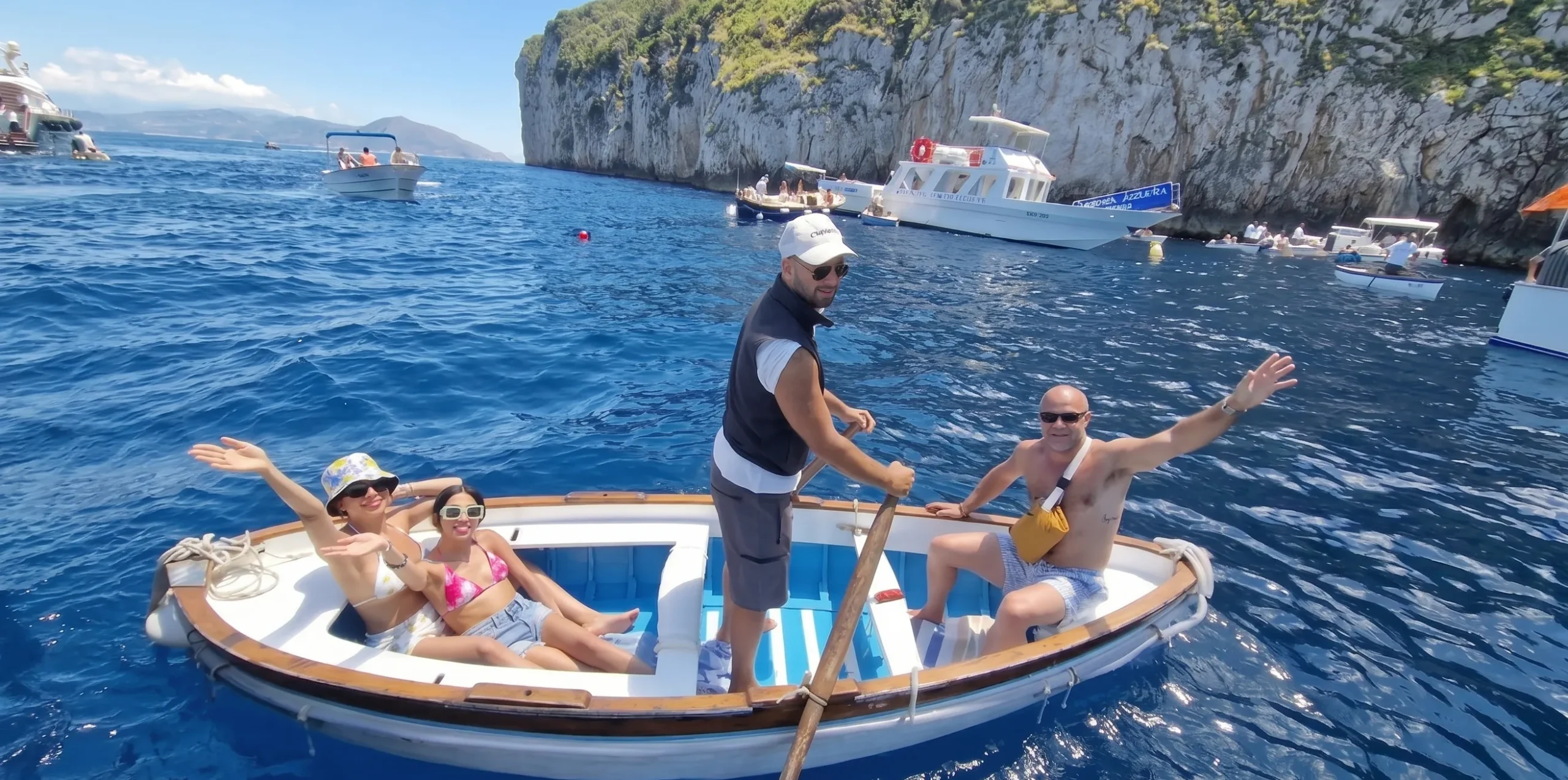
The Blue Grotto Capri doesn’t start at the cave entrance. It starts earlier — out on open water, when the coastline pulls back and the island stops feeling like a destination and starts feeling like something you’re slowly earning.
You don’t rush toward it. You circle, you wait, you watch other boats disappear into that low cut in the rock and come back out quieter than before. That’s usually when curiosity turns into something harder to name.
Summary
- What a Blue Grotto tour actually feels like from the sea
- Why is the Blue Grotto so famous?
- What is the best time of day to visit the famous blue sea cave?
- How a Capri boat tour changes the whole experience
- Starting from Sorrento: where the day really begins
- Shared or private: two ways to do it right
What a Blue Grotto tour actually feels like from the sea
A Blue Grotto tour is not a straight line. It’s a slow approach, and the approach is part of it.
You see the entrance before you understand it. A small, dark gash in the limestone, barely above the waterline. Boats gather nearby — not pushing, just holding position, waiting their turn. The sea moves gently. Everything feels slightly suspended.
Then it’s yours.
You shift from the main boat into something smaller. The skipper says a few words. And suddenly the world narrows to that opening — closer to the water than you expected, lower than it looked from a distance.
For one second it feels too tight.
Then you’re inside.
The light doesn’t hit the water the way light normally behaves. It filters up from below, diffuses through a submerged opening in the rock, and turns everything into a color that has no real equivalent on land. Not turquoise, not cobalt. Something between the two, shifting, almost alive.
Voices carry differently in there. Even small movements feel amplified. It’s a short visit — a few minutes at most — but the compression of it, the contrast between the open sea outside and the stillness inside, stays longer than the photographs do.
For everything that happens before and after the grotto, on the same day: “Capri boat tour: what you really see when you leave the shore”.
Why is the Blue Grotto so famous?
It’s not just the color. Or at least, not only that.
The Blue Grotto Capri became famous in the 19th century when German writer August Kopisch documented it — though local fishermen had known about it for centuries and largely avoided it, believing it was haunted.
That history adds something to the place, even if most visitors don’t know it when they’re ducking under the entrance.
What makes it stay with you is the contrast. Outside: sun, movement, boats, noise. Inside: everything compresses. The ceiling is low. The blue light rises from below. Time does something strange — not stopping exactly, but loosening.
And then, almost before you’ve settled into it, you’re back out in the glare of a normal afternoon. The sea looks brighter than before. Colors are sharper. It takes a few minutes to readjust.
That’s the thing about the Blue Grotto. You don’t fully understand it while you’re inside. It makes more sense later, when you’re back on the boat looking at the cliffs, and something has quietly shifted.
What is the best time of day to visit the famous blue sea cave?
Early morning is the honest answer — and not just because of the crowds.
The light inside the Blue Grotto is at its most intense when the sun is still low and the angle through the submerged opening is direct. Mid-morning, on a clear day, is when the blue does what it’s supposed to do. Later in the day the effect softens, sometimes significantly.
There’s also a practical layer. The cave closes when the sea is too rough — waves above a certain height make the entrance impassable. Morning tends to be calmer.
By afternoon, conditions can shift without much warning, especially in shoulder season.
Midday visits can work on flat, windless days, but the queue outside tends to stretch longer and the heat on the water is unforgiving.
Late afternoon is a gamble. Sometimes the light is extraordinary. More often, it’s already closed.
The window exists. Catching it means structuring the day around the cave rather than the other way around.
How a Capri boat tour changes the whole experience
Visiting the Blue Grotto as a standalone trip and visiting it as part of a Capri boat tour are two genuinely different days.
On a Capri boat tour, the grotto becomes one moment inside a longer story. You’ve already spent time on the water — passed the Faraglioni, watched the coastline change texture, maybe stopped somewhere quiet.
By the time you reach the cave you’re already in a different register. Less tourists, more travelers.
With a private setup the flexibility compounds this. If the entrance is too rough in the morning, you circle back later. If the line outside is long, you move on — to the Grotta Verde, to a cove off the southern coast, to somewhere with no name on the map — and return when the timing improves.
Sorrento Sea Tours tends to work this way. Not a fixed itinerary with the Blue Grotto as the mandatory centrepiece, but a day that reads the conditions and adjusts. The route exists. It just doesn’t run you.
Starting from Sorrento: where the day really begins
If you leave from Sorrento, the day starts before Capri comes into view — and the coast between Marina Piccola and the open sea is worth paying attention to.
The first thing you notice, minutes from the harbor, is the Bagno della Regina Giovanna. A natural pool carved into the limestone at sea level, enclosed by low cliffs, with the ruins of a first-century Roman villa sitting above it on the promontory.
The same spot where, according to local history, Queen Giovanna II of Naples kept her private retreat, screened from the mainland by the shape of the rock itself. From the water you see the ruins exactly as they were meant to be seen — from below, against the sky.
Further along, the coast sheds its tourist surface. Puolo Bay appears — small, quiet, with Vesuvius sitting on the horizon as if placed there for perspective.
Then the shoreline becomes wilder: the cliffs of Massa Lubrense, the scattered fishing hamlets, a small natural waterfall that drops straight from the rock into the sea. These are places most visitors never see because there’s no road to them, no signpost, no carpark.
The water here is part of a protected marine area.
Clearer than anywhere on the coast. Below the surface, at Scoglio del Vervece, there’s a submerged statue of the Madonna placed at twelve meters depth to mark one of Enzo Maiorca’s historic freediving records. Most people pass over it without knowing.
By the time you reach Punta Campanella — the western tip of the peninsula, where the Gulf of Naples ends and the Gulf of Salerno begins — the landscape has changed completely.
Then Capri appears. Low on the horizon, solid, almost unhurried about it.
That crossing matters. By the time you arrive at the island you’ve already been at sea long enough for everything else to recede. The Blue Grotto, when you reach it, doesn’t feel like a checkpoint. It feels like the natural continuation of something that began the moment the harbor disappeared behind you.
Most of the Sorrento Sea Tours experience leaves from Marina Piccola — which means that coast, and everything it holds, is already part of your day before Capri even begins.
Something stays with you after the Blue Grotto Capri — but it’s not always what you think it will be.
Not just the blue, though the blue is real. It’s the moment before entering, when the opening looks too small. The way the light shifts below the water. The particular quiet inside the cave, even when other boats are nearby.
And then the open sea again, arriving all at once — brighter, louder, almost too much for a few seconds.
The grotto is brief. Everything around it is what gives it weight.